Tratamiento de lodos
Alfa Laval suministra soluciones para el tratamiento de aguas residuales que cubren todo el proceso de tratamiento de lodos, incluyendo la deshidratación, la espesamiento, el tratamiento térmico, el postratamiento y la recuperación de recursos. Gracias a nuestra larga trayectoria en el sector del agua, combinamos amplios conocimientos y experiencia con soluciones IoT probadas, incluyendo una gama completa de sistemas de control que reducen el uso de polímeros y energía.
Ventajas de nuestras soluciones para el tratamiento de lodos
- Reduzca hasta un 90 % los residuos, ahorrando en transporte, eliminación de efluentes, almacenamiento y costes de secado.
- Abrir nuevas fuentes de ingresos a partir de la recuperación de recursos.
- Minimice el impacto medioambiental con procesos eficientes y sostenibles.
- Reducción de los costes operativos gracias a una mayor eficiencia de la planta.
- Optimizar el uso de polímeros y energía en todo el proceso operativo para cumplir con normas más estrictas.
El espesamiento y la deshidratación de lodos in situ es una parte fundamental de todos los procesos actuales de tratamiento de aguas residuales para reducir el volumen de lodos, el coste de eliminación de residuos y cumplir los requisitos de sostenibilidad. También es muy importante que los lodos se utilicen como alimentación para digestores producción de biogas, procesos térmicos y compostaje. Para satisfacer las necesidades específicas de cada planta, Alfa Laval ofrece tecnologías robustas y probadas, desde el espesamiento y la deshidratación hasta el tratamiento térmico de lodos, lo que le ayuda a mejorar su gestión de lodos y su perfil de sostenibilidad.
Sludge thickening process
In the primary or secondary treatment of wastewater, it has become standard practice to mechanically thicken sludge from clarifiers before it undergoes digestion or dewatering. Managing high water flows and diluted slurries presents significant challenges in municipal and industrial wastewater treatment plants. To achieve cost efficiency and enhanced performance, it is crucial to reduce the hydraulic load and increase slurry concentration before dewatering and digestion.
Alfa Laval offers a wide range of cost-efficient sludge thickening solutions that sustainably reduces the sludge volume for further downstream processing. All our sludge thickening machines have enclosed designs , which requires very low maintenance and odour control:
Gravity belt thickeners
Flocculation sludge thickening, suitable for all municipal or industrial flocculated sludges AS-H Belt Thickeners are integrated with polymer mixing for small to medium capacity.
Decanter centrifuges
Aldec, Aldec G3 or Aldec G3 VecFlow sludge decanters for high performance centrifugal separation and sludge thickening and dewatering with high cake dryness.
Sludge dewatering process
The dryness of sludge from municipal and industrial wastewater treatment significantly impacts transportation, effluent disposal, storage, and drying costs. Alfa Laval offers a range of cost-efficient sludge dewatering technologies that effectively separate liquid phases and achieve high dry solids content, helping customers meet legislative requirements for sustainable sludge disposal.
Depending on the desired dry solids content, available space, and other requirements, customers can choose from several Alfa Laval technologies for efficient sludge dewatering and liquid separation from waste streams:
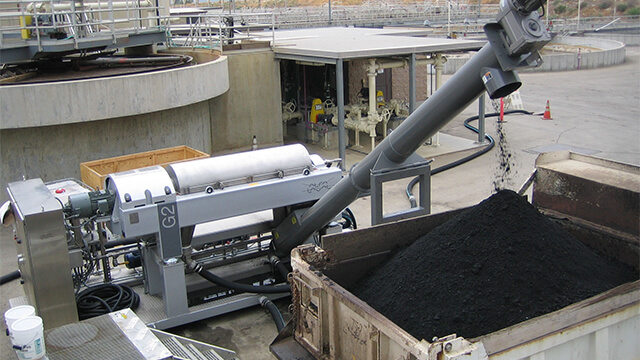
Belt presses
AS-H belt presses for high volume and solids loading with low polymer and power use.
Filter presses
AS-H plate presses for smaller batches where very high dry cake solids (up to 40%) and solids capture over 99% is required.
Decanter centrifuges
ALDEC G3 and ALDEC G3 VecFlow for very high capacities with very small footprint and low energy consumption. It has up to 5x capacity on the same footprint as a conventional belt press. These are Alfa Laval’s latest generation of sludge dewatering equipment for municipal and industrial wastewater treatment.
Some of these can also be used for mud dewatering, mine tailings, pond clean-up and dredging. It can also be used for drinking water, seawater desalination, biogas, biosolids, manure treatment, industrial wastewater treatment from food and bev and energy and industrial production.
Thermal sludge treatment process
Thermal sludge treatment processes, including mesophilic and thermophilic digestion, are essential for breaking down organic matter in wastewater. Mesophilic digestion operates at moderate temperatures, while thermophilic digestion uses higher temperatures to accelerate the process. Both systems rely on key components such as tube-in-tube heat exchangers, sludge-to-water and sludge-to-sludge spirals, and plate heat exchangers (PHE) to optimize heat transfer and digestion conditions. These systems are critical for enhancing the biodegradability of sludge and supporting efficient waste treatment.
Alfa Laval offers a comprehensive range of heat exchangers, including gasketed plate heat exchangers and spiral heat exchangers, designed to maximize the efficiency of thermal sludge treatment. Our systems support processes like sludge hydrolysis, pasteurization, and anaerobic effluent evaporation, which reduce waste volume, recover valuable resources, and ensure compliance with environmental standards. Alfa Laval's technologies also provide solutions for cost savings, heat recovery, and the production of high-quality biogas or compost. For specific industrial applications, such as pharmaceutical waste, pasteurization is essential to ensure pathogen reduction and meet regulatory requirements.
Tube-in-tube heat exchangers
Tube-in-tube heat exchangers designed speficially to handle heating and cooling of sludge containing fibres and particles.
Spiral heat exchangers
Spiral heat exchangers, specifically the ALSHE SW, STW and STS spiral heat exchangers, are intended for sludge/ water applications. The heat exchanger offers unique abilities within sludge treatment applications such as mesophilic digestion, thermophilic digestion, sludge hydrolysis or pasteruisation, pre-heating and heat recovery.
Gasketed plate heat exchangers
For larger duties, we have our classic gasketed plate heat exchangers to handle mesophilic digestion, thermophilic digestion and sludge hydrolys or pasteurization.
Case stories