
Compabloc Free Flow
Compabloc Free Flow de Alfa Laval es un condensador compacto con una eficiencia de transferencia de calor muy alta diseñado específicamente para la industria farmacéutica y los altos requisitos higiénicos de la producción de API moderna. El diseño higiénico, el alto rendimiento, los bajos costes operativos y la fácil instalación se combinan para garantizar la seguridad de los pacientes, un tiempo de funcionamiento fiable y una producción eficaz.
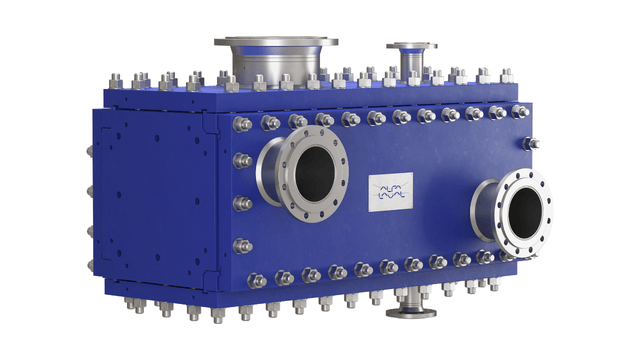
Incluya una mayor capacidad de condensación en el espacio existente en su producción de API
- Fácil de validar: cumple con los requisitos de instalación en procesos de cGMP
- Diseño completamente soldado y disponible en materiales resistentes a la corrosión, la sustitución perfecta para bloques de grafito o carcasa y tubos
- Diseño higiénico de vanguardia que hace que la limpieza sea rápida, fácil y fiable, y los bajos volúmenes de retención reducen el uso de disolventes
- El tamaño compacto y el peso reducido le permiten aumentar la capacidad incluso cuando el espacio es limitado, perfecto para la renovación
- Bajos costes de funcionamiento y mantenimiento probados
Patient safety and cGMP
Compabloc Free Flow offers state-of-the-art hygienic design and fully meets the requirements for installation in stringent cGMP processes. This makes Compabloc Free Flow suitable for pharmaceutical processes such as API manufacturing
New possibilities with compact condenser
Patrik Arvidsson, Business Manager at Alfa Laval, explains the benefits of using compact condensers in API production.
Ease of cleaning and inspection
Efficient cleaning of the reactor condenser is vital for patient safety. A difficult to clean condenser increase carry-over and cross-contamination between batches. For a multi-purpose reactor this can be disastrous if different medicines mix. It can also be a serious problem for a single-purpose reactor since it reduces traceability. Cleaning and validating the cleaning for a Compabloc Free Flow is quick and easy thanks to the full drainability and absence of crevices, dead spots and contact points on the product side. Inspections are performed easily through the nozzles or by simply opening the panels, giving you full access to all product-wetted surfaces.
Perfect for API manufacturing processes
Graphite blocks are widely used as condensers in API manufacturing processes thanks to their ability to withstand aggressive media. However, as many pharmaceutical companies have experienced, graphite blocks have a major disadvantage. They release carbon particles and resin into the product stream. Compabloc Free Flow is available in corrosion-resistant materials, making it the perfect replacement for graphite block condensers in API manufacturing.
Cómo funciona
How the Alfa Laval Compabloc Free Flow works
At the core of Compabloc Free Flow is a stack of corrugated heat transfer plates made of stainless steel or alloy C22. The hygienic design is unique and the result of many years of research and development. The plates are welded alternately to form separate channels for the process vapour and cooling medium. As the vapour flows through the product-side channels, it condenses on the cold plates. The wide free-flow channels provide very low pressure drop, making Compabloc Free Flow ideal for deep-vacuum condensing duties. On the cooling-media side, baffles direct the flow back and forth through the channels, increasing turbulence and heat transfer efficiency.
Two-pass condensing is the preferred configuration for most API applications. In the first pass, primary condensation takes place as the condensable vapour contacts the cold plates. The condensate flows down and exits through the sloped, fully drainable bottom panel.
The remaining vapour, containing non-condensables and any residual condensable vapour, then enters the second pass, where it is further cooled to maximize condensation. The turbulence in this pass helps eliminate entrained mist, while the outlet provides an efficient point for pulling vacuum.
With the two-pass configuration, vapour-liquid separation takes place inside the condenser, eliminating the need for a gas-liquid separator.
Single-pass condenser
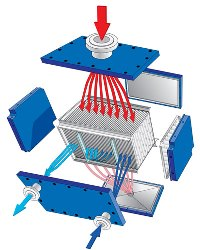
This version is suitable when the vapour contains small amounts of inert gases. Vapour enters through the big inlet on the top panel and condenses on the plates. The condensate exits through the sloped, drainable bottom panel.
Two-pass condenser
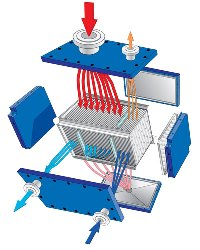
The two pass version can be used when the vapour contains a larger portion of inert gases. Main condensation takes place in the first pass where the condensable part of the vapour condenses on the plates before exiting through the sloped, drainable bottom panel.
The non-condensable vapours go through the second pass where they are sub-cooled to maximize condensation. Turbulence in the second pass helps to eliminate mist, and vacuum is easily drawn from the outlet of the second pass. With a two-pass condenser there is no need for an additional vapour separator, since separation takes place in the unit.